Liveshopping for Salesforce: How to Bring Live Video Shopping to Your Salesforce Commerce Cloud Store
Over the past few months the conversation has shifted. Nobody is asking whether liveshopping is real anymore. The question now is: what does it look like for us? Is it going live on social channels, or is it bringing a new kind of content into a space we already own? Brands are experimenting. Some are seeing great success, others less so. But the truth is, every brand needs an answer to the question: how are we going to approach liveshopping?
“This is the era of live social shopping and for many of you here, retailers, family business owners, creators, influencers .. this is going to be a massive opportunity.”
Shoppers don't just want to see products anymore. They want to watch them demonstrated, ask questions in real time, and buy while they're still excited. For brands running on Salesforce Commerce Cloud, that opportunity is especially big, and liveshopping is quickly becoming one of the most effective ways to turn browsers into buyers.
The challenge is that many live shopping tools were built for Shopify first, leaving enterprise and mid-market Salesforce merchants to piece together workarounds. This guide is written for marketing leaders who need to make a call. It covers the two main approaches to liveshopping, the business case, what a Salesforce-ready setup actually requires, the metrics that matter, and a practical 90-day pilot plan.
Chapter 01The Two Approaches to Liveshopping: Off-Site vs. Onsite
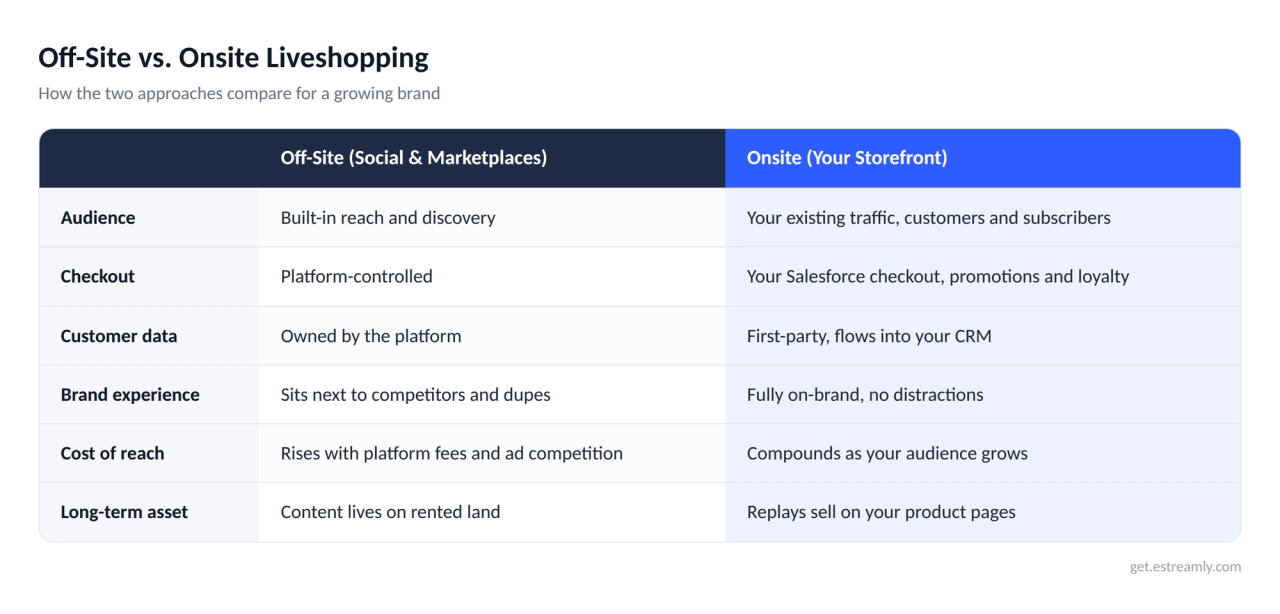
Strip away the buzzwords and every liveshopping strategy comes down to one decision: do you go live where the audience already is, or do you bring the audience to you?
Off-Site: Selling on Someone Else's Platform
This includes marketplaces and social platforms like TikTok Shop, Whatnot, and eBay Live. The upside is obvious: built-in audience and discovery. You show up where your customer is already scrolling. Retail giants like QVC now run dedicated live shopping channels on TikTok, which tells you everything about where the audience has moved.
The downsides are just as real. You don't control the checkout, the customer data, or the community. You don't own the land, so you're vulnerable to being outbid in your own category, and you're always working for the algorithm rather than the other way around. And when a knock-off of your bestseller shows up in the same feed at half the price, the platform isn't going to protect your brand.
Onsite: Liveshopping on Your Own Storefront
Using a software provider like eStreamly, you bring the live event to your own site. Customers watch and shop directly from your website, which means you own the data, the journey, the checkout, and the customer experience. No more customers demanding a refund on a product that turned out to be a dupe of yours!
The difficulty is getting people to your site at the right time. But this is where the long game pays off. Go live consistently and you build a real relationship with your audience, and that relationship turns into community. Beate Johen is an industry leader here: going live on a regular schedule with large viewing numbers on their own site, customers coming back for the content week after week and staying for the whole event. (Audience attention for more than five seconds, who knew it was possible!)
The Smart Play: Do Both, Own the Conversion
For most mid-sized brands, this isn't an either/or decision. The strongest programs use social for reach and their own storefront for conversion and relationship. With multistreaming, you can broadcast one show to Instagram, YouTube, and Facebook while the shoppable version runs on your site, so social viewers discover you and your best customers buy through a checkout you control.
Chapter 02Why Liveshopping Belongs in Your Marketing Plan
Liveshopping earns its place in the budget when you look at what it does across the funnel, not just on the night of the show.
It answers the questions that stop people buying. How does it fit? Is the fabric see-through when you squat? Does the color look like the photo? A live host can answer those in seconds, in front of hundreds of shoppers at once. For apparel and activewear brands, where fit and feel drive both conversion and returns, that's a big deal.
It's one of the most efficient content engines you have. One hour of live can become a shoppable replay, a stack of short-form clips, product page videos, and email content. Compare that to the cost per asset of a traditional shoot.
It builds first-party data and community. Every viewer who registers for a reminder, asks a question, or buys is a relationship you own, and a signal you can use in your CRM and retargeting.
It makes launches feel like events. New collections, limited drops, and seasonal moments get urgency and a story, not just a homepage banner.
What this could look like for a premium activewear brand: A weekly “Fit Check” show hosted by a brand ambassador and a studio instructor, trying on the new drop in different sizes and answering sizing questions live. A launch-night show for each seasonal collection. Athlete Q&As that feel like community, not a sales pitch. Every replay then lives on the product pages it featured, answering the same fit questions for shoppers who arrive days later.
Chapter 03Why Salesforce Merchants Need a Purpose-Built Liveshopping Solution
Salesforce Commerce Cloud powers some of the most sophisticated storefronts in ecommerce, with complex catalogs, multi-region pricing, promotions, and carefully managed checkout flows. A liveshopping tool that doesn't respect that complexity creates more problems than it solves.
Platform compatibility matters more than most buyers realize. Some popular video commerce tools are optimized primarily for Shopify. If your live shopping platform can't sync with your Salesforce catalog, inventory, and cart, you end up maintaining a parallel store, reconciling orders manually, and losing the attribution data that justifies the investment. That's not a conversation any CMO wants to have with their CFO.
The right liveshopping for Salesforce setup should feel like an extension of your existing commerce stack, not a bolt-on.
Chapter 04What to Look For in a Salesforce Liveshopping Platform
When evaluating live streaming options for Salesforce ecommerce, focus on these capabilities.
Native catalog and checkout integration. Products, prices, promotions, and stock levels should flow in from Salesforce automatically, and viewers should check out through your existing cart. Anything else introduces friction and data gaps.
Multistreaming reach. Your audience isn't only on your website. Look for the ability to broadcast once and reach your storefront, mobile app, and social channels simultaneously.
Unified chat and moderation. When comments come in from multiple platforms at once, your team needs a single view to keep up, answer questions, and filter spam.
Replay and repurposing. A live event shouldn't be a one-time asset. The best platforms turn replays into shoppable video on product pages, in email, and across social.
Revenue attribution. You should be able to tie orders back to specific shows, channels, hosts, and products, so you know what's working and can defend the budget.
Enterprise-grade security. Salesforce merchants typically have rigorous security and compliance reviews. Your live shopping vendor should make that process easy, not add months to it.
Data ownership. You should keep full control over your customer relationships and transaction data rather than handing them to a third-party marketplace.
A lean-team workflow. Most mid-sized brands don't have a broadcast team. The platform should let a small marketing team plan, go live, and repurpose without a production studio.
Chapter 05How eStreamly Delivers Liveshopping for Salesforce
eStreamly is a video commerce platform designed to make live streams, recorded video, and social content shoppable wherever your customers are, and it supports Salesforce alongside other major ecommerce platforms. Here's how it lines up against the criteria above.
It plugs into your Salesforce catalog. eStreamly pulls in catalog, checkout, and existing media from Shopify, BigCommerce, Magento, Salesforce, and custom builds, inheriting your inventory and pricing in real time. There's no separate cart, no migration, and no parallel store to maintain, so your merchandising team keeps working in Salesforce as usual.
Go live once, sell everywhere. A single broadcast can stream simultaneously to Facebook, Instagram, YouTube, your storefront, your mobile app, and embedded players, using a phone, laptop, or external camera. For more advanced productions, you can also broadcast via RTMP.
One inbox for every conversation. Comments from every platform land in a single inbox, with auto-moderation filtering spam and abuse in real time, and hosts can pin questions and reply once so viewers see the answer on their own channel.
Every show keeps selling. When you go off-air, the replay automatically becomes shoppable video on your product pages, plus highlight clips, email content, and landing-page assets. One live event feeds your content calendar for weeks.
Attribution you can act on. eStreamly reports performance by channel, product, and host, showing which moment of which stream drove which order, and that data can feed back into retargeting.
Built for security reviews. The platform runs on AWS and is a Visa partner, which helps Salesforce teams move through IT and compliance approval faster.
You own the relationship. Merchants keep full ownership and control over transactions and each viewer's information.
Beyond live. Liveshopping is most powerful as part of a broader video commerce strategy. eStreamly covers both live shopping and shoppable video, with AI generation from catalog data and UGC content workflows, so the long tail of SKUs that never get a live segment can still have video on the product page.
Chapter 06The Metrics That Matter
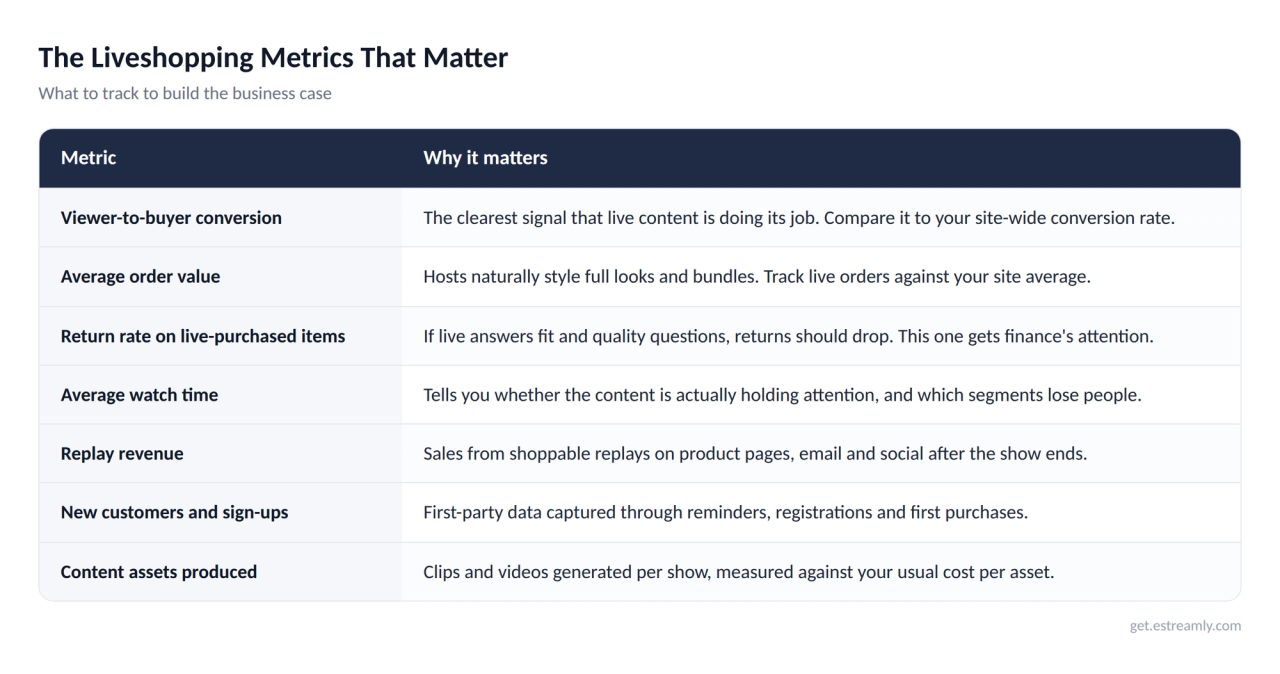
Before your first show, agree on what success looks like. Vanity numbers like peak viewers are nice for a Slack message, but these are the metrics that build the business case.
Chapter 07Getting Started With Liveshopping on Salesforce
Launching your first live shopping event doesn't require a production studio. A practical rollout looks like this:
- Connect your Salesforce store so your catalog, pricing, and checkout sync with the live player.
- Pick a focused first show, such as a product launch, seasonal collection, or “how to use it” demo. Feature a handful of hero products rather than your whole catalog.
- Choose a host, whether that's an in-house expert, a store associate, or a creator partner. Authenticity beats polish every time.
- Stream across channels to your site, app, and social at once, with a moderator managing the unified chat.
- Repurpose the replay onto product pages and into email and social clips.
- Review the attribution data, then iterate on timing, products, and hosts for the next show.
A 90-Day Pilot Plan
The brands that win with liveshopping treat it as a program, not a one-off stunt. A 90-day pilot gives you enough shows to learn and enough data to make a real decision.
- Days 1–30: Set up and launch. Connect Salesforce, define your KPIs, pick your host, and run your first show around a product your customers already love. Promote it through email, SMS, and social so your warmest audience knows exactly when to show up.
- Days 31–60: Build the habit. Commit to a regular cadence, weekly or every other week, at the same time. Consistency is how onsite audiences grow. Test formats: try-ons, launches, expert Q&As.
- Days 61–90: Measure and decide. Compare live and replay performance against your benchmarks, identify your best-performing hosts and formats, and build the case to scale, adjust, or rethink.
On team size: a lean pilot typically needs a host, a producer to run the show and feature products, and a moderator on chat. At the start, that can easily be three people from your existing marketing and ecommerce teams.
Chapter 08Frequently Asked Questions About Liveshopping for Salesforce
Does liveshopping work with Salesforce Commerce Cloud?
Yes. Several platforms integrate with Salesforce Commerce Cloud, including eStreamly, which syncs your catalog, inventory, pricing, and checkout so viewers can buy during the stream.
Should we go live on social, on our site, or both?
Most mid-sized brands get the best results from both: social for discovery and reach, your own storefront for conversion, data, and community. Multistreaming lets you do both from a single show.
How do we get people to our site at the right time?
Treat each show like a launch. Promote it through email, SMS, social, and on-site banners, let shoppers set reminders, and go live on a consistent schedule so your audience builds the habit.
Do shoppers have to leave the stream to buy?
Not with eStreamly. Viewers can add to cart and purchase without leaving the live experience, using your existing Salesforce checkout.
How do we measure ROI?
Track viewer-to-buyer conversion, average order value, return rates on live-purchased items, replay revenue, and new customers captured, then compare them against your site benchmarks and content production costs.
What happens to the video after the live event?
The replay becomes shoppable video you can place on product pages, in emails, and across social, so each event keeps generating revenue.
Do I need professional equipment or a big team?
No. You can start with a smartphone or laptop and a small team of about three people, then scale up to multi-camera productions via RTMP as your program grows.
Chapter 09Ready to Launch Liveshopping on Salesforce?
Every brand needs an answer to the liveshopping question, and for Salesforce merchants the best answer is one that builds on the stack you already have. Liveshopping brings the energy of in-store selling to digital channels without rebuilding your commerce stack. With native catalog and checkout integration, multistreaming, unified moderation, shoppable replays, and detailed attribution, eStreamly is built to help Salesforce brands go live, own the relationship, and sell everywhere their customers are.
Book a demo at get.estreamly.com to see how liveshopping for Salesforce can work for your brand.