Shoppable Video ROI is no longer a “nice to have” metric—it’s becoming a core lever for conversion, content attribution, and overall media efficiency across your entire ecommerce funnel. In the rapidly evolving landscape of e‑commerce, static product pages alone are no longer enough to capture and convert today’s discerning consumers, especially when video is now one of the most influential formats in purchase decisions.
Shoppable videos are emerging as a powerful differentiator, not only for your Shoppable Video ROI but also to transform online shopping from passive browse to active engagement and purchase intent. They reduce friction, give shoppers a “see it, tap it, buy it” path, and provide marketers with a far clearer read on content performance and revenue attribution. This blog post will break down the critical “why” and “how” of integrating shoppable video into your marketing strategy, with practical insights and best practices to help you drive sales, enhance customer experience, and future‑proof your brand.
Chapter 011. The “Why” – Business Value & Shoppable Video ROI
Chapter 02How does shoppable video directly impact sales and revenue?
Shoppable videos drive revenue by stripping out steps between inspiration and purchase, much like one‑click checkout did when it collapsed a 4–5 step flow into a single tap. By letting viewers click directly on products inside the content, brands remove the need to jump to a bio link, find the right product page, or re‑search the item on Google or Amazon. This reduction in friction is proven to lift conversion and reduce cart abandonment, echoing what we’ve seen with 1‑click checkout flows that can move conversion from roughly 2–3% toward high‑single‑digit or better.
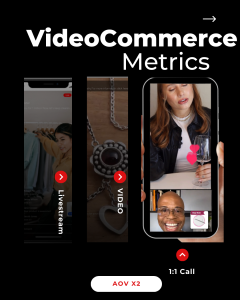
While shoppable video has not consistently proven to increase AOV, its real power is in making content ROI measurable: you can attribute sales to specific videos, formats, creators, and placements with much more precision than traditional PDP or static content. This closes the loop between content investment and revenue impact, giving marketing and ecommerce leaders the confidence to double down where performance is strongest.
Chapter 03What is the expected Shoppable Video ROI?
Shoppable Video ROI varies by placement and traffic source, and the numbers shift meaningfully depending on whether the content is on‑site, in email, used in ads, or in organic social.
Shoppable Video on organic social posts usually sees lower product views and add‑to‑carts per unique session (~40% and 5% respectively), but compared to “link in bio” workflows, it’s a substantial improvement in conversion and data capture.
- Shoppable video (typically UGC) on Product Description Pages (PDPs) tends to deliver the strongest conversion efficiency, with: ~80% product views per session
- 30–40% add‑to‑carts per session. However, only about 10% of PDP visitors will actually engage with video, which is why optimizing that experience is critical. Here is an ROI calculator we created to help ecommerce leaders model Shoppable Video ROI against their own metrics.
- Shoppable Video in Email often shows 60%+ product views and ~8% add‑to‑carts per unique session, reflecting very high intent per viewer and significantly higher watch time (around 67% more) vs. on‑site traffic.
- Shoppable Video Ads typically deliver strong mid‑funnel and bottom‑funnel performance, with around 78% views per session and 14% add‑to‑carts per session; one client reported 2x ROAS when sending traffic to an eStreamly‑powered shoppable experience versus redirecting to standard PDPs.


How does it improve the customer journey and overall user experience?
The most impactful user experience can be narrow down to 3 uses cases
- Video on PDP: For shoppers still undecided, PDP video provides real‑world context, social proof, and “people like me” representation, making it easier to visualize use cases and reduce purchase anxiety.

- Video in email: Email subscribers are in a more relaxed, “lean‑back” mode; they may not be actively shopping, but they are willing to give you time. Video in email consistently drives higher click‑through and longer engagement—watch time can be ~40% higher than site content—which makes it a natural spot for shoppable storytelling.
- Video ads landing page: When users click through an ad, they’re granting permission to sell to them; sending them to a static PDP after they’ve just been entertained on social can be jarring. A shoppable, social‑style video landing page maintains continuity, feels native, and is less disruptive, which helps preserve intent and boost conversion.
Does it reduce friction in the purchasing process?
Yes—this is one of the most direct Shoppable Video ROI drivers. Instead of asking viewers to:
- “Go to the link in bio”
- Navigate your website to hunt for a specific product
- Or search your brand or product on Google or Amazon
you allow them to tap directly on product tags, hotspots, or embedded carousels inside the video. This “watch, tap, buy” path mirrors the impact of one‑click checkout by reducing steps, decisions, and latency between desire and action, leading to higher conversion and lower abandonment.
Can it help with customer acquisition and retention?
Most merchants initially see shoppable video as a customer acquisition lever; in reality, unless you are heavily investing in paid media, shoppable video is a powerful retention and loyalty tool. It deepens engagement with existing customers, provides richer product education, and keeps your brand top‑of‑mind through ongoing, episodic content. A particularly insightful interview from thehead of Video commerce from Flipkart explores how video commerce is reshaping retention and repeat purchase behavior.
How does it differentiate our brand from competitors?
Most ecommerce sites still operate like digital catalogs: grids of static images, basic PDPs, and minimal interactivity. Shoppable video lets you evolve beyond that into a more experiential, content‑rich environment where personalization, video, and AI intersect. Very few merchants have robust on‑site video commerce today, which means early adopters can materially differentiate on experience, storytelling, and Shoppable Video ROI long before the rest of the market catches up.
Chapter 04 2. The “How” – Implementation & Technology:
What are the different types of shoppable video having an impact on ROI?
There are different type of shoppable videos
- Short form: Ideal for grabbing attention, generating interest, and delivering a quick and short message
- Long form: ideal to provide more context on the product, company story or product demo
- Liveshopping: Great for driving community engagement, urgency, instant gratification, sharing in depth product value, handle objections live, showcasing multiple products and how it your product is the answer your customer has been searching for.
- 1 to1 video: Concierge on the Go! Ultra‑personalized experiences for high‑value customers or high‑consideration purchases, which can drive materially higher AOV and stronger loyalty.
What technology and platforms are required to implement shoppable video?
eStreamly enables you to create a scalable video commerce ecosystem—turning every video and livestream into a shoppable moment across web, ads, email, social, SMS, and more. Every video becomes a micro‑ecommerce experience that connects directly to your ecommerce platform, so you don’t need multiple disjointed tools to drive add‑to‑cart behavior and track revenue from video content.
How complex is the technical setup and ongoing maintenance?
For ecommerce platforms with existing integrations, setup is straightforward. eStreamly has plugin integrations with Shopify, Magento, Adobe Commerce, Bigcommerce, Commerce Cloud/ Demandware. Allowing for a simple installation.
Merchants on custom websites would need to expose APIs (for product feeds and add‑to‑cart events), but once connected, they can build dynamic players that adapt behavior based on page context and content type.
With a strong video merchandising layer, ongoing maintenance can be lightweight: the platform handles much of the logic around where and how videos appear, letting teams focus on content quality and strategy rather than manual placement.
How do we add product tags, clickable links, and other interactive elements effectively?
Tagging and interactivity are critical to both performance and Shoppable Video ROI. A few non‑negotiables:
- Ensure product tagging is directly tied to your ecommerce catalog rather than static product URLs; this prevents broken links over time and keeps inventory and pricing states accurate.
- Prioritize platforms with rich interactive features (product hotspots, overlays, carousels, connections to socials, forms) that can capture first‑party data such as product interests and engagement signals.
- Look for strong video merchandising tools that allow semi‑autopilot deployment—letting your video commerce engine select and place the right videos in the right spots based on behavior, product, and performance. At eStreamly, we view merchandising as a core success driver, not a “nice add‑on.”
Chapter 053 . The “What If” – Performance, ROI & Analytics:
How do we measure the performance of shoppable videos? What KPIs (Key Performance Indicators) should we track?
We recommend monitoring the following KPIs based on the traffic source. Being able to associate those KPIs by traffic is very important in your understand of overall performance.
Content
- Impressions
- Views
- Unique session
- Total Engagement
- Sentiment analysis (in the case of a livestream)
- Unique session user journey
- Watch time

Commerce
- Product views
- Click-through rates
- Total Add to cart value
- Average Add to cart value
- Newly identified users
- Sales attributed to video at 24hours, 7 days, 30 days. We recommend using a pixel or leveraging a serverless tracker
What kind of analytics and reporting capabilities do shoppable video platforms offer?
Platforms offer various levels of analytics. Comprehensive analytics will enable you to dive in further. We recommend using a platform that can support Google Tag Manager, Facebook Pixel, 3rd party data tracking and UTM such as on the eStreamly platform. For the very large merchant, an integration to data lake software is a plus
Are there A/B testing capabilities for different video formats or calls to action?
For the most savvy merchant A/B testing capability on platform is very valuable especially when coupled with AI. Company like FermatCommerce have great capabilities in this area for shoppable videos ads.
Chapter 064. The “Practicalities” – Content & Operations:
What kind of content performs best as shoppable video?
Typically, live shows drive high watch time, high engagement but need a strong hook and call to action. Product reviews & demos trigger strong engagement especially when done by creators or as UGC. Although watch time is typically lower, these videos earn strong interaction per view. They are most valuable in decision-making moments (PDPs, emails).
Corporate videos, while important when used next to product image carousels on PDPs, will drive less engagement. We typically do not recommend those videos to be shoppable but to focus interactivity on UGC style videos that will drive engagement and be frequently updated.
Best practices for video production specifically for shoppable content?
- Lighting: Use bright, even, and natural-looking lighting to showcase product details clearly. Avoid harsh shadows or overexposure.
- Audio: Ensure clear, crisp audio with minimal background noise. Use external microphones.
- Pacing: Keep videos concise (30-45 seconds is often ideal) and engaging with dynamic visuals and quick cuts. Maintain a brisk pace to hold attention. We have customers using 7-10 seconds videos with great success.
- Clear Product Showcasing: Focus on unique selling points, benefits, and how the product solves a problem. Use close-ups and demonstrations to highlight key features and show the product in realistic, everyday situations. Do not overload your videos with too many features. Benefits >> Feature
How can we scale our shoppable video efforts?
- Strategic Planning: Start with clear goals and a content calendar. Identify anchor content (longer-form videos) that can be segmented and repurposed. We recommend using a blueprint if you are considering doing a livestream
- Repurposing: Break down longer videos into shorter clips for various platforms (e.g., Reels, TikTok). Convert video content into blog posts and social media snippets. Software like capcut or opus.pro are really helpful. At eStreamly, we provide a blog idea, and 3-6 AI clipped videos from each livestream.
- Templates & Batch Production: Create video templates for consistency and efficiency. Schedule dedicated time to record multiple videos in one session.
- User-Generated Content (UGC): Encourage and leverage customer-created content, which is authentic and cost-effective. Sometimes customers can become your best creators, that what happened to Battlbox – check this podcast to find how they turn a customer creator into a content machine that drives over $20m of revenue
What resources (staff, budget, time) are typically needed for a successful shoppable video initiative?
- Staff: If you have a good video merchandising solution, it should not require more than 30-45 minutes per week. If you want to create specific content, like for a liveshopping, you may want a dedicated content creator/videographer, editor, and potentially a social media manager for distribution and engagement. For larger initiatives, a marketing strategist to oversee the video content.
- Budget: Varies widely, Shoppable video will be more affordable. From a technology perspective, it will range from less than 50 dollars per month, to 4-6,000 per month with the most advanced solution. Check how eStreamly can fit your budget. Liveshopping will typically require a much higher budget and time allocation commitment.
How does shoppable video fit into our broader marketing strategy and content calendar?
- Synergy & Integration: Embed shoppable videos across your website (PDPs, landing pages), email marketing, SMS campaigns, and social media.
- Customer Journey: Align shoppable video content with different stages of the customer journey, from awareness (short, engaging social clips) to conversion (detailed product demos on PDPs).
- Content Calendar: Plan shoppable videos within your overall content calendar, coordinating with product launches, promotions, seasonal campaigns, and marketing themes.
- Cross-Promotion: Promote your shoppable videos across all your marketing channels (email, social, ads) to maximize reach and drive traffic.
- Analytics: Regularly track key metrics (conversion rates, click-through rates, engagement) to inform future strategy and demonstrate ROI.
The data is clear: shoppable video ROI is not just a fleeting trend but a fundamental shift in how consumers interact with products online. From significantly reducing purchase friction and boosting conversion rates to enriching the customer journey and offering unparalleled content ROI, the benefits are undeniable. By strategically integrating shoppable video across your website, email, and social channels, leveraging robust platforms, and focusing on high-quality, engaging content, you can unlock new avenues for growth and truly differentiate your brand in a crowded market. It’s time to move beyond the digital catalog and embrace a dynamic, interactive shopping experience that resonates with modern consumers and drives tangible results. Checkout how eStreamly can help you to further monetize your video content and optimize your total media spent to drive positive outcome in revenue and great shopper journeys.